
JOURNAL · ENERGY & SLEEP
Winter Fatigue Isn't What You Think
Performer 8 Editorial Team · 9 min read · Updated October 2026
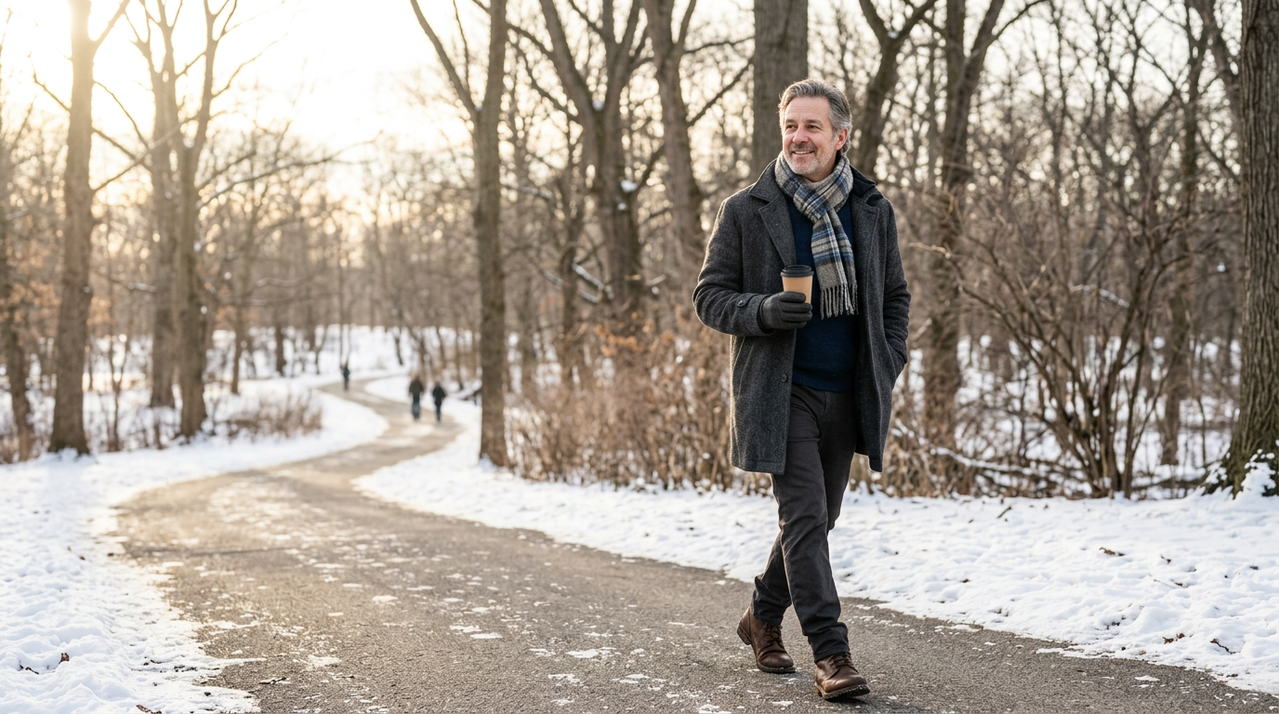
In Tromsø, in the far north of Norway, the sun doesn't rise above the horizon for two full months¹.
Two months. No sunrise.
You'd expect the people there to be the most worn-out, winter-weary people on earth. But when researchers surveyed Norwegians in 2020, they found something odd. The further north people lived, the more positive they felt about winter. And the people who felt most positive about it also reported more satisfaction with their lives¹.
Hold on to that. We'll come back to it.
Meet David
Now picture a man in his late forties. Call him David. He isn't a real person, but you probably know him. You may be him.
David sleeps his seven hours. He eats reasonably well. He isn't lazy.
And yet every January, his energy disappears.
He wakes up feeling as if he hasn't slept. By 3pm he's onto his second coffee, and it isn't working. By 8pm he's asleep on the sofa.
David blames his age. Or his willpower. Or just life.
He's wrong on all three counts. What David has is winter fatigue, and he has a lot of company. In a 2023 American Psychiatric Association poll, about one in four US adults said they feel more tired in winter, and 31% said they sleep more².
The clock behind the curtain: why winter makes you tired
Here's the thing most of us were never taught. Your body doesn't decide how alert to be on its own. It takes orders.
And the most important order arrives through your eyes³.
Every morning, light tells your internal clock that the day has started. In June, that message arrives early and loud. In January, it arrives late and faint, if it arrives at all.
Sleep specialists at Henry Ford Health explain what happens next. Shorter days disrupt your circadian rhythm, and your body makes more melatonin, the hormone that makes you sleepy⁴.
So when David drags himself out of bed in the dark, he isn't weak. He's responding, quite sensibly, to a signal that says it's still night.
That changes the question. David has been asking, "What's wrong with me?"
The better question is, "What is my body being told?"
Three small thefts
Winter doesn't take David's energy all at once. It takes it a little at a time.
The first theft is light. We've covered that one.
The second is vitamin D. Your skin makes it from sunlight. In the UK, between October and early March, we don't make enough vitamin D from sunlight⁵. Older adults lose out most, because skin makes less vitamin D as we age⁶.
The third is the sneakiest: movement. Dark evenings and cold mornings quietly remove the walk, the gardening, the trip to the shops on foot. Nobody decides to stop. It just stops.
Does cold weather make you tired?
Which brings us to a popular idea. Does the cold itself make you sleepy?
Only partly. The cold is less a culprit than an accomplice. Cold days come with less light, more time indoors and less movement.
So if you've wondered why the cold makes you sleepy, the honest answer is this: it's mostly about what the cold stops you doing.
Winter fatigue or the winter blues?
Most winter fatigue looks something like this:
- Harder mornings, and wanting to sleep longer
- A deeper afternoon slump
- Less interest in going out
- Craving heavy, carb-rich food
- Feeling flat, rather than truly low
For some people, though, it goes further.
Seasonal affective disorder, or SAD, is a type of depression that usually happens in winter and goes away in summer. The NHS lists symptoms including low mood, a lack of interest in things you usually enjoy, and being more tired and sleeping more than usual⁷.
But here's the dividing line. It isn't how tired you feel. It's how much your life is affected.
Feeling slower in winter is common. Feeling hopeless, losing interest in things you usually enjoy, or struggling to function is something to take to your GP or doctor.
If you ever have thoughts of harming yourself, in the UK and Ireland you can call Samaritans free on 116 123, at any time. In an emergency, call 999 in the UK or 112 elsewhere in Europe.
The surprising power of ten minutes
If light is the problem, light is also the fix. This is where the story turns.
A panel of international sleep and light scientists recommends plenty of bright light during the day, ideally daylight, because it supports alertness and better sleep at night⁸. The NHS gives the same advice for SAD: get as much natural daylight as you can⁷.
In practice, that means something almost embarrassingly simple:
- Get outside early. Ten to 20 minutes of daylight within an hour of waking, even on a grey day. Henry Ford's sleep team recommends opening the blinds and heading outside soon after you wake⁴.
- Keep one wake time, weekends included. The NHS recommends getting up at the same time every day, and says adults need 7 to 9 hours of sleep⁹.
- Put the phone down an hour before bed. Light at night can shift your rhythm and disrupt sleep³.
For SAD, doctors sometimes use a very bright 10,000-lux light box for 30 to 45 minutes first thing in the morning¹⁰. That's a conversation for your doctor, not a weekend project.
Why do I sleep more in winter?
Partly because your body is asking for it.
Darker mornings delay the light signal that tells you to wake up, so you naturally want to sleep in³˒⁴. One study of patients at a Berlin sleep clinic even found about 30 minutes more REM sleep in winter than in spring¹¹.
So the urge to stay under the covers isn't laziness. It's biology. The answer is to give your body a stronger morning signal, not to fight it with willpower.
The coffee that lies to you
Then there's caffeine, where most of us fool ourselves.
In one study, people who took caffeine six hours before bed lost more than an hour of sleep¹².
Here's the strange part. They didn't notice¹².
They felt fine. They were not fine.
The NHS advises avoiding tea, coffee and alcohol for at least 6 hours before bed⁹. A simple experiment: stop at 2pm for a week and see what happens to your nights.
The paradox of spending energy
Here's the most counterintuitive part of all. To feel as if you have more energy, you have to spend some.
A review of 12 population studies found that physically active adults were less likely to report low energy and fatigue than inactive ones. The more active they were, the stronger the link¹³. Studies like that can't prove cause and effect. But the pattern held.
Then researchers at the University of Georgia tested it directly. They took inactive adults and had them do 20 minutes of low-intensity exercise, three times a week, for six weeks.
Energy rose by about 20% compared with a group that didn't exercise. Fatigue fell by 65%¹⁴.
The volunteers were younger adults, so don't read too much into the exact numbers. But notice how low the bar was. Not marathons. Not boot camps. Twenty easy minutes.
What that looks like for David:
- A brisk 20-minute walk at lunch. Movement and daylight in one go.
- Exercise earlier in the day, finishing a few hours before bed⁴.
- A week that adds up. The NHS recommends at least 150 minutes of moderate activity a week, plus strengthening exercises on 2 days¹⁵.
- Something small every day. Ten minutes daily beats a big weekend session you skip when it rains.
The afternoon slump isn't (only) your lunch
We tend to blame the 3pm dip on whatever we ate at midday.
But the afternoon slump is partly built into your body clock. It can happen even if you skip lunch altogether¹⁶.
That said, what you eat may still make it worse¹⁶. So build lunch around protein, vegetables and wholegrains, and save the heavy comfort food for the evening.
If you nap, keep it to about 20 minutes, between midday and 3pm. Longer or later naps can disrupt your night⁴.
Why men over 40 should pay attention
Winter doesn't treat men over 40 differently. But a few things make the slump easier to notice, and more worth taking seriously.
Sleep apnoea. It becomes more likely with age and is more common in men than women. Extra weight, alcohol and smoking raise the risk further¹⁷.
In one large US study, about 1 in 10 men aged 30 to 49, and about 1 in 6 aged 50 to 70, had moderate to severe sleep-disordered breathing¹⁸.
If David is told he makes gasping, snorting or choking noises in his sleep, wakes up unrefreshed or nods off during the day, he should see his GP¹⁹.
Other causes. Persistent tiredness can be linked to anaemia, an underactive thyroid or blood pressure problems⁴˒²⁰. That's no reason to panic, and the NHS advises against self-diagnosing²¹. It is a reason not to write tiredness off as "just winter" if it won't lift.
Vitamin D. The NHS advises adults in the UK to consider a daily supplement containing 10 micrograms of vitamin D in autumn and winter, and not to take more than 100 micrograms a day⁵.
Guidance differs between countries, so if you live elsewhere in Europe, ask your doctor or pharmacist. Vitamin D can interact with some medications, so check before adding a supplement¹⁰.
When to see your GP
The NHS advice is refreshingly plain.
If you've been feeling tired for a few weeks and you're not sure why, see your GP¹⁹.
Get emergency help if tiredness comes with chest pain, shortness of breath, an irregular or fast heartbeat, or a feeling that you might pass out²⁰.
What David does this week
Nothing dramatic.
- Daylight before 10am. Ten to 20 minutes outside, even if it's cloudy.
- One fixed wake time. Seven days, weekends included.
- No coffee after 2pm. Then notice his nights.
- A 20-minute walk at lunch. When the light is strongest.
- A lighter lunch. Protein and vegetables first.
- A date in the diary. If nothing has changed in a few weeks, he books a GP appointment.
BRAND NOTE
Where Performer 8 fits
Those habits do most of the work. No supplement replaces them.
We make Performer 8 as a daily formula for men over 40 who want some support alongside those habits. So here's an honest look at three of its ingredients:
- Magnesium. Magnesium contributes to a reduction of tiredness and fatigue²². Fatigue and weakness can be early signs of low magnesium, though true deficiency is uncommon in otherwise healthy people²³. Leafy greens, nuts, seeds and wholegrains come first.
- KSM-66 ashwagandha. A root extract from a herb with a long history in traditional medicine. Research on it is still at an early stage. The NIH describes small, short-term trials looking at stress and sleep, and says long-term safety isn't known. It may not suit everyone, including men with prostate cancer, people with thyroid conditions, and anyone on diabetes, blood pressure, immune or sedative medication²⁴.
- Caffeine. It's why Performer 8 belongs with breakfast, not the afternoon. Keeping caffeine to the morning helps protect your sleep¹²˒⁹.
One thing Performer 8 doesn't contain is vitamin D. So it's no substitute for daylight, or for vitamin D advice from your doctor.
The full ingredient list is on the label and on our product page. Every order comes with a 60-day money-back guarantee. If you take medication or have a health condition, check with your doctor before starting any supplement.
See what's inside Performer 8
Back to Tromsø
So what were those Norwegians doing right?
They weren't getting more sunlight. They had none.
What the researchers found was a difference in mindset. People who saw winter as a season with its own pleasures, not just something to endure, tended to feel better¹. The study can't prove which came first. But it hints at something useful.
Winter fatigue is real. The dark mornings, the extra melatonin, the missing walks: none of that is in your head.
But how much winter takes from you depends partly on what you give back. A little morning light. A walk. An earlier last coffee. A little less dread.
David was never broken. He was just getting the wrong signals.
And signals, it turns out, can be changed.
Frequently Asked Questions
Yes. Shorter days shift your body clock, and your body tends to make more melatonin when mornings are dark⁴. Being more tired and sleeping more than usual are common in winter, and they are also symptoms of SAD⁷. It's worth seeing your GP if it's severe, affects your mood or daily life, or doesn't improve with better sleep, daylight and activity.
Mostly because of what comes with it. Cold weather usually means darker days, more time indoors and less movement, and all of those lower alertness. Getting daylight early and staying active do more than turning up the heating.
In the UK, between October and early March we don't make enough vitamin D from sunlight, and the NHS advises considering a daily 10 microgram supplement in autumn and winter⁵. Studies of vitamin D for winter mood have mixed results¹⁰. If you're tired all the time, ask your GP rather than guessing at doses.
Darker mornings delay the light signal that tells your body to wake up, so you naturally want to sleep in³˒⁴. A consistent wake time and getting outside soon after waking help reset it⁹.
The dip is partly built into your body clock¹⁶. A lighter lunch, a walk in daylight and, if you nap, about 20 minutes before 3pm all help⁴. Avoid a late coffee to push through: the NHS advises no tea or coffee for at least 6 hours before bed⁹.
If you've felt tired for a few weeks and you're not sure why, see your GP¹⁹. Get urgent help if tiredness comes with chest pain, shortness of breath or a racing heartbeat. If low mood includes thoughts of self-harm, call Samaritans on 116 123 in the UK and Ireland, or 112 in an emergency elsewhere in Europe.
References
1. Leibowitz K, Vittersø J. "Winter is coming: Wintertime mindset and wellbeing in Norway." International Journal of Wellbeing, 2020. https://internationaljournalofwellbeing.org/index.php/ijow/article/view/935
2. American Psychiatric Association. "With fewer daylight hours, time change can affect mental health" (media advisory and Healthy Minds poll), 2023. https://www.psychiatry.org/News-room/News-Releases/MEDIA-ADVISORY-With-Fewer-Daylight-Hours-Time-Chan
3. Blume C, Garbazza C, Spitschan M. "Effects of light on human circadian rhythms, sleep and mood." Somnologie, 2019. https://pubmed.ncbi.nlm.nih.gov/31534436/
4. Henry Ford Health. "Why Do You Feel More Tired In The Winter?" (Luisa Bazan, MD, sleep medicine), 2021. https://www.henryford.com/blog/2021/01/more-tired-in-winter
5. NHS. "Vitamin D." https://www.nhs.uk/conditions/vitamins-and-minerals/vitamin-d/
6. NIH Office of Dietary Supplements. "Vitamin D: Fact Sheet for Health Professionals." https://ods.od.nih.gov/factsheets/vitaminD-healthprofessional/
7. NHS. "Seasonal affective disorder (SAD)." https://www.nhs.uk/mental-health/conditions/seasonal-affective-disorder-sad/
8. Brown TM et al. "Recommendations for daytime, evening, and nighttime indoor light exposure to best support physiology, sleep, and wakefulness in healthy adults." PLOS Biology, 2022. https://journals.plos.org/plosbiology/article?id=10.1371%2Fjournal.pbio.3001571
9. NHS. "Insomnia." https://www.nhs.uk/conditions/insomnia/
10. National Institute of Mental Health. "Seasonal Affective Disorder" (NIH Publication No. 23-MH-8138), 2023. https://www.nimh.nih.gov/health/publications/seasonal-affective-disorder
11. Seidler A et al. "Seasonality of human sleep: polysomnographic data of a neuropsychiatric sleep clinic." Frontiers in Neuroscience, 2023. https://www.frontiersin.org/articles/10.3389/fnins.2023.1105233/full
12. American Academy of Sleep Medicine. "Late afternoon and early evening caffeine can disrupt sleep at night" (Drake C et al., Journal of Clinical Sleep Medicine, 2013). https://aasm.org/late-afternoon-and-early-evening-caffeine-can-disrupt-sleep-at-night/
13. Puetz TW. "Physical activity and feelings of energy and fatigue." Sports Medicine, 2006. https://www.doi.org/10.2165/00007256-200636090-00004
14. Puetz TW, Flowers SS, O'Connor PJ. "A randomized controlled trial of the effect of aerobic exercise training on feelings of energy and fatigue in sedentary young adults with persistent fatigue." Psychotherapy and Psychosomatics, 2008. https://karger.com/pps/article/77/3/167/282404/ (summary: University of Georgia, https://news.uga.edu/?p=4930)
15. NHS. "Physical activity guidelines for adults aged 19 to 64." https://www.nhs.uk/live-well/exercise/physical-activity-guidelines-for-adults-aged-19-to-64/
16. Askaripoor T et al. "Effects of light intervention on alertness and mental performance during the post-lunch dip." Industrial Health, 2019. https://pmc.ncbi.nlm.nih.gov/articles/PMC6685797/
17. National Heart, Lung, and Blood Institute. "Sleep Apnea: Causes and Risk Factors." https://www.nhlbi.nih.gov/health/sleep-apnea/causes
18. Peppard PE et al. "Increased prevalence of sleep-disordered breathing in adults." American Journal of Epidemiology, 2013. https://pubmed.ncbi.nlm.nih.gov/23589584/
19. NHS. "Tiredness and fatigue." https://www.nhs.uk/symptoms/tiredness-and-fatigue/
20. Mayo Clinic. "Fatigue: When to see a doctor." https://www.mayoclinic.org/symptoms/fatigue/basics/when-to-see-doctor/sym-20050894
21. NHS. "Why am I tired all the time?" https://www.nhs.uk/live-well/sleep-and-tiredness/why-am-i-tired-all-the-time/
22. Commission Regulation (EU) No 432/2012, list of permitted health claims made on foods. https://eur-lex.europa.eu/legal-content/EN/TXT/HTML/?uri=CELEX:32012R0432
23. NIH Office of Dietary Supplements. "Magnesium: Fact Sheet for Health Professionals." https://ods.od.nih.gov/factsheets/Magnesium-HealthProfessional/
24. NIH Office of Dietary Supplements. "Ashwagandha: Is it helpful for stress, anxiety, or sleep?" (Health Professional Fact Sheet), 2025. https://ods.od.nih.gov/factsheets/Ashwagandha-HealthProfessional/
This article is for general information and is not medical advice. Speak to your doctor before changing your diet, exercise or supplement routine, especially if you have a health condition or take medication. Food supplements should not be used as a substitute for a varied, balanced diet and a healthy lifestyle.